
An occasional series on chapbooks, broadsides, and other printed ephemera.
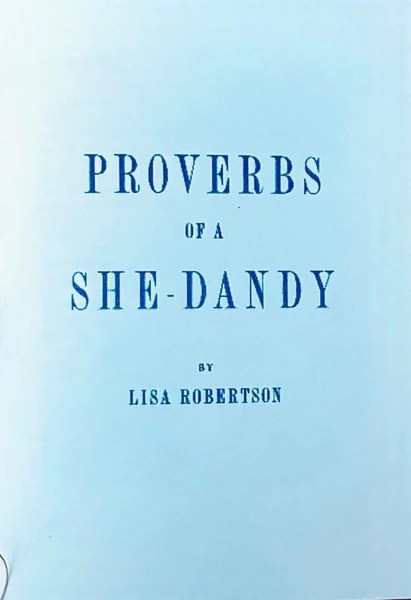
“She is the masterpiece of the ancient superiority of the improductive. She neither begets nor works, but drifts.” Thus sayeth Lisa Robertson, author of Proverbs of a She-Dandy, a small chapbook by Cutt Press. At a mere 48 pages, this 2024 edition is a pocket version of the original work from 2018 “published by the Morris and Helen Belkin Art Gallery.”
Despite its small size, Proverbs provides a delicious richness, offering an introductory essay, the aforementioned proverbs, and two poems by Charles Baudelaire translated by Lisa Robertson. As Robertson explains in her essay “To the Reader,” “Charles Baudelaire was born in 1821, the same year the word ‘menopause’ was coined by Parisian doctor Charles de Gardanne, in his book De la Ménopause ou de l’âge critique des femmes. It was also in 1821 that the English word ‘dandy’ first entered literary use in France, with Charles-Louis Lesur in his Annuaire historique universal, an annual collation of administrative, financial, meteorological and diplomatic documents, with a chronicle of events and notes contributing to the history of arts and letters.” In the essay, Robertson explains the nature of the Baudelairean dandy and then linking it to Gardanne’s description of menopause. Both fly in the face of the utilitarian and the useful.
For Robertson, the Baudelairean dandy “is the subtraction of all utility and all ambition from everyday life.” At the same time, Gardanne said menopause “is the loss of the signs of female reproductive ability.” The relationship between the social stance and the physiological condition seem obvious. The dandy shuns work and its attendant “usefulness,” and menopause makes a woman less useful, at least in the draconian terms of being a baby-making machine. Proverbs then becomes a beautifully rebellious document. Robertson goes on to say, “After menopause the female was manlike, so could take on masculine practices.” Like embracing the concept of becoming a dandy. She also connects dandyism to the lifestyle of an older individual. This is contrasted to such youth culture trends like hipsters, beatniks, punks, and others. A menopausal woman becomes “enacts an urban destabilization” and “problematizes the very necessity of productivity.” Although with the Earth’s population at 8 billion people, those who bewail declining birth rates sound ridiculous and idiotic. Then again, aren’t these the same intellectual vanguards who see selling more guns as the solution offered after every mass shooting? Is the use-value of a fertile woman an actual genuine sentiment or a kitschy gloss smeared over a thinly-veiled desire to see a female body as a flesh-and-bone site of industrialized production? There’s a very short step from worshiping the Mother and dehumanizing a woman into livestock.
Robertson’s proverbs offer meditations on these same questions and concerns. “Unlike almost any other adult human body hers now possesses extra organs, organs that have eclipsed all use value. She will decide what to do with her inner wealth, which is entirely autonomous.” Like a distaff Oblomov or Bartelby, the she-dandy has the right and choice to say, “I will do nothing.” With menopause, she has the protection from the masculine catcalls for increased reproduction, those who want to turn every woman into a Uterine Stakhanov. Maybe every woman doesn’t want to turn her body into a termite queen pumpin’ out shorties. Even in the United States, women dying in childbirth is still a thing. On top of the potential biological horrorshow ever-present throughout pregnancy.
Proverbs begins with this one: “She will consider the concept of menopause and its pathological code as one of the covert products of modernity.” This is coupled with dandyism, a social phenomenon associated with an industrial capitalist modernism. One is reminded of the flaneur, one who wanders aimlessly throughout the Paris shopping arcades.
The chapbook ends with Robertson’s translation of “Hags” and the prose-poem “Widows.” These translations build on to Robertson’s larger project examining Paris and Charles Baudelaire. The Baudelaire Fractal and Riverworks explore these hidden histories, giving Robertson an unofficial crown of a modern-day Walter Benjamin. Proverbs is a unique work, an essay, proverbs, and translation, told from the perspective of a menopausal woman. It is an intellectual exercise and, simultaneously, a book of hidden wisdom.


