
An occasional series on chapbooks, broadsides, and other printed ephemera.
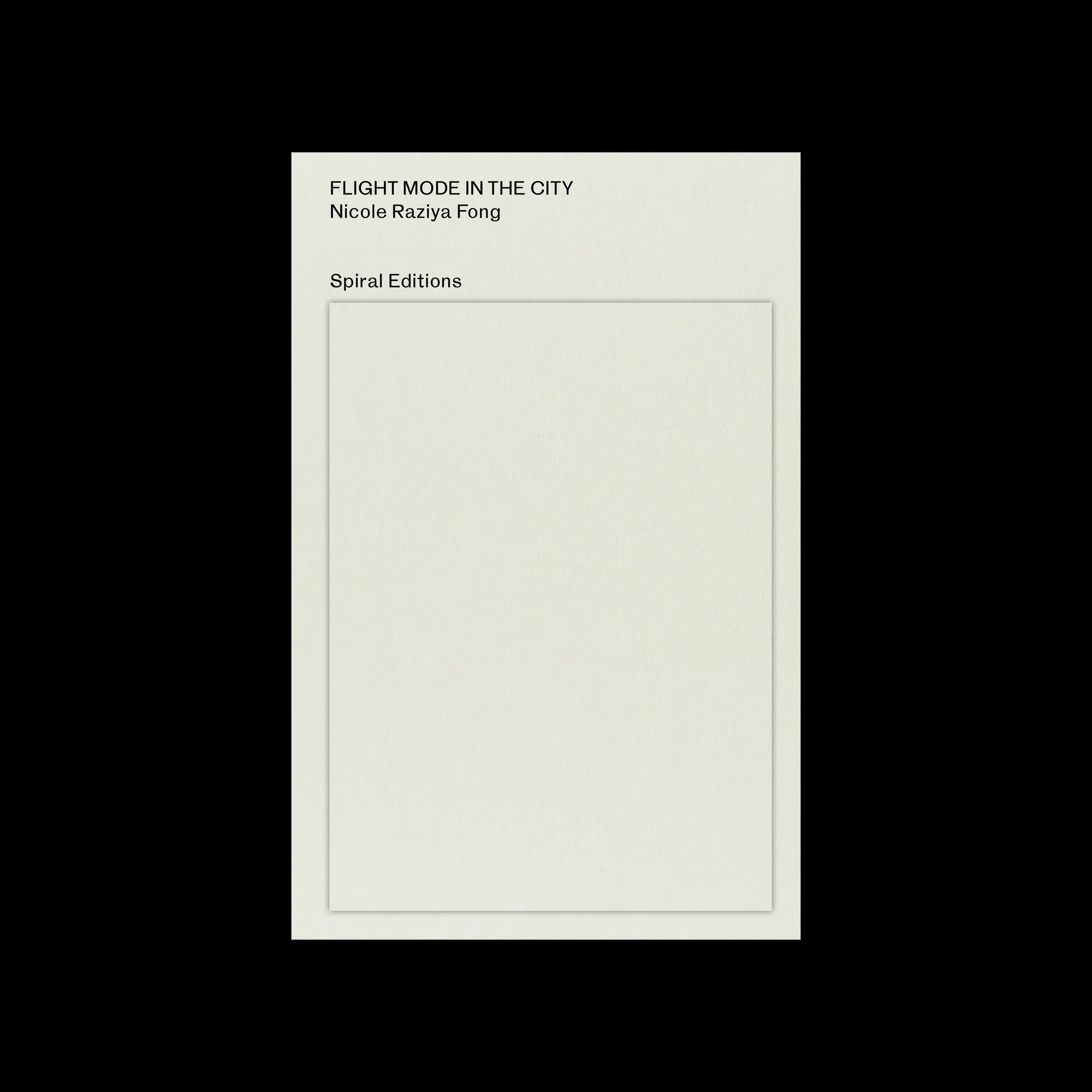
Spiral Editions
First Edition © 2023
#57 / 125 copies
“You bought the mirror / Aware of what you’d see …” So goes a line in the first poem of Flight Mode in the City, by Nicole Raziya Fong. This slim chapbook, published by Spiral Editions in a tiny print run of 125, meanders around concepts of self and identity. Although saying what this small collection of poems is “about” would be a move too simplistic, too reductive. It would be a Procrustean futility, a critical straitjacket, and an attempt to rationalize the otherwise subjective aesthetics at work. Although a critical attempt will be made, albeit one made as an engagement and conversation with the piece. One should sometimes avoid the pretensions of literary criticism, especially when it comes to making definitive and final pronouncements. To inject a bit of personal anecdote, when I first read Flight Mode, my first reactions were the questions: “What is this?” “What is this about?” And, finally, “How do I possibly explain this to a reader looking for a brief book review?”
Living in Quebec, Fong’s “work seeks to delimit and reconstruct immaterial ampoules of psychic experience, coaxing the incorporeal into inhabiting a more muscular physique.” (from their website) Flight Mode uses the entire space of the blank field to play, manipulate, and explore the limits of the word and image. (See below an example of a two-page spread.)
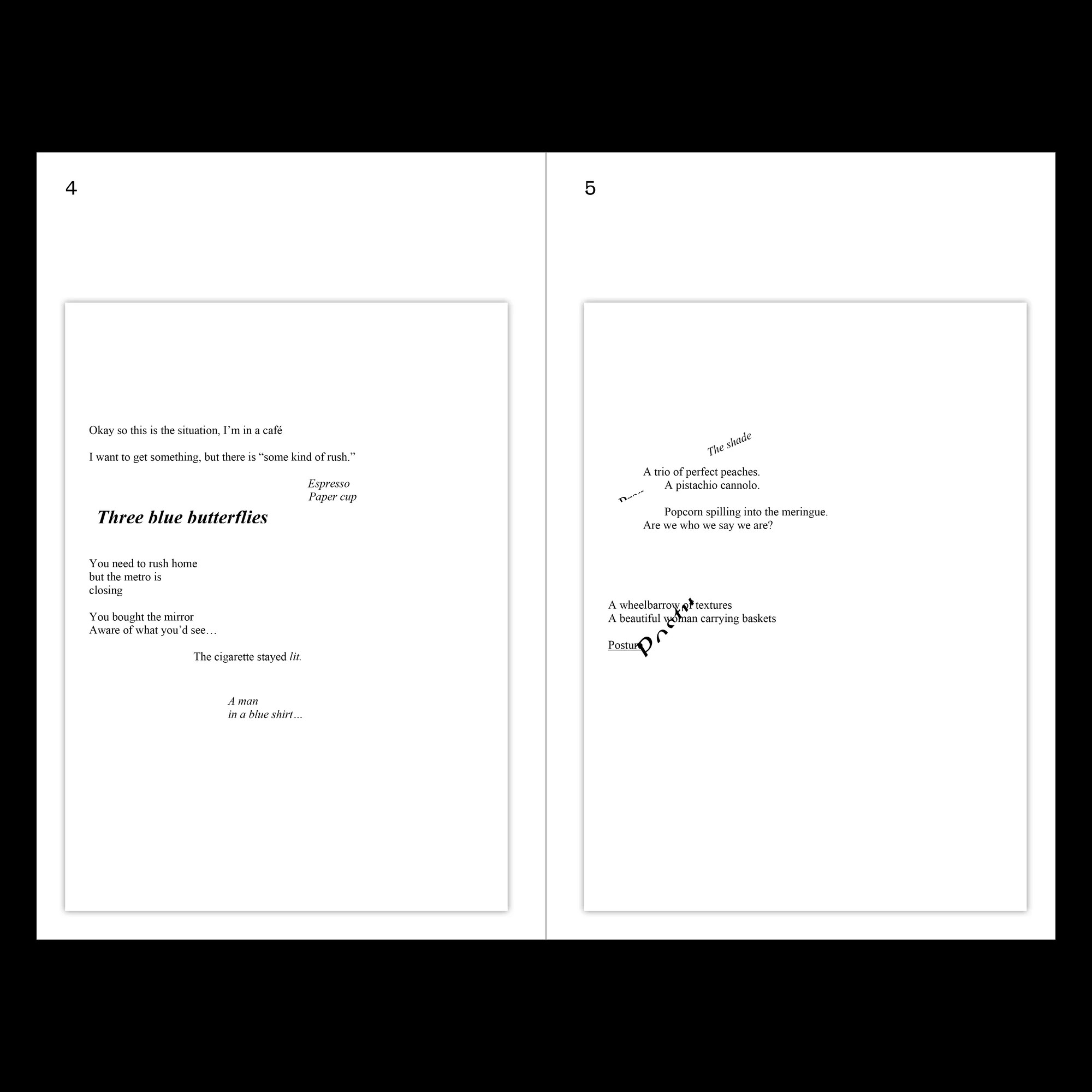
Various font sizes, emphases (regular, bold), angles, and overlap commingle with the textual content. “Are we who we say we are?” The question is answered with a possible non sequitur: “A wheelbarrow of textures” The page ends with “Posture” Then the word is repeated, albeit both enlarged and cut in half. The poem reads as both a homage and parody of Mallarme’s dice roll and a sly reference to William Carlos Williams’s poem “Red Wheelbarrow.” Yet again, these could be critical projections, another attempt to yield literary street cred with the game of reference spotting. Another function of the binary argument of intellectual archaeology versus emotional engagement? Not every literary work requires smarty-pants checkboxing.
In the sequence “Theory of the Stars,” the first poem begins:
Art
has something
to do with
sincerity
A key is found in “Orname/ntation”: (cite in full below)
Writing is, in
this sense,
very
difficult …
Figura
l in the sense
of
being
legible
as
author
ity,
oth
erw
ise,
“the
known”
…
When something is legible, this presumes coherence, and further presumes an accessibility to “the known.” Thus, if it legible, then we are better able to know what the content is. Ergo, what’s the poet talking about. In the previous poem, “Blue / sleeves,” Fong says “The shade of / purple is: // ‘Exactitude.’” But is it though?
What can seem most confounding can, in actuality, be what’s most enjoyable about Flight Mode. Figuring out it’s “aboutness.” The Spiral Editions description cites Lacanian psychoanalysis and disembodied theorizations, which is all fine and good, but in the end, I would recommend avoid reading any summary and simply enjoying these poems, engaging with their textual-visual acrobatics and erotics. Meld together the brain and the eye, intellectual and sensuality, into a unique reading experience. Analyzing and understanding the poetry within is important, but not all-important. As much as Fong engages in experiencing art through their own unique lens, the same can be said for any potential reader of Flight Mode. It can be a challenge to understand, “to get,” what they are saying and/or presenting, since the amalgamation of text and image go beyond both text and image as individual elements. Fong uses the entire page as a field of play and the reader is invited, not just to ponder and pick apart, but to have fun with it. Enjoy!

 The Driftless Area Review