
Small-sized reviews, raves, and recommendations.
Dennis’ Mother: Oh there you go, bringing class into it again!
Dennis: But that’s what it’s all about! If only people would realise…
— From Monty Python and the Holy Grail (Terry Gilliam and Terry Jones, 1975); “The Constitutional Peasant Sketch”
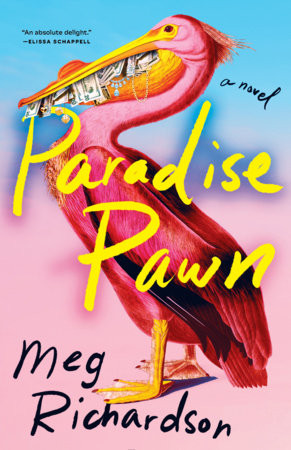
Have you heard the one about the two middle-school girls who set up an embezzlement scheme in a Florida pawn shop? Kayla and Jackie are best friends. Their dads both work for Paradise Pawn, a chain of Florida pawn shops. Kayle and Jackie have been BFFs forever, but high school will be where this might end. Jackie received a scholarship, so she will be able to attend St. Bridget’s, a private Catholic high school in Cherry Beach, Florida. Inspired by this crisis, the pair concoct a scheme to raise money for Kayla to attend. Paradise Pawn, by Meg Richardson, chronicles the perpetuation of this confidence scheme and its ultimate unraveling.
Richardson, who has personal experience working in pawn shops, is an author and cartoonist. Her illustrations pepper the text, each chapter showing an icon that foreshadows the plot. Like a tropical working class bildungsroman, Paradise Pawn captures, with laser-like precision, the everyday trials and tribulations of being a teenage girl in tourist trap America. Despite being teenagers, Kayla and Jackie know their stuff. They are adept in the appraisal of jewelry, understanding how to spot a knock-off. It takes skill and know-how to figure out if a piece of gold jewelry is gold-plated or the actual metal.
At first, Kayla is reluctant to go along with Jackie’s scheme. Then Kayla discovers her mother is pregnant. Since babies cost money – unless you’re a Republican male politician and don’t understand how a fetus and one’s pocketbook are connected because of Jesus or whatever – Kayla accepts Jackie’s scheme. The money that could have been used to pay for her to attend St. Bridget’s will instead be funneled into an additional mouth to feed. While Kayla’s mother is pregnant, Jackie’s mother is not present. Her absence involves an illness and grief, an absence Jackie is still dealing with, all the while contending with adolescent hormones, her dad’s handsy boss, and the brutal realities of class in America.
Paradise Pawn is a fun beach read and a brilliant portrait of being a teenage girl. Told from Jackie’s perspective, her voice feels authentic and realistic. Not an easy feat. The biggest challenge to writing young characters is avoiding years of adult experience to bleed through and contaminate childhood ignorance. Jackie’s scheme and the consequences that follow make her “grow up.” Much of growing up is sloughing off the chrysalis of innocence and ignorance. Jackie learns about how her body is changing, but also about what it means to “be rich.” Her dad’s boss and his spoiled son come across as rich to Jackie, mostly because they are their employers. They are, to use a turn of phrase, a poor person’s idea of a rich person. While Jackie and her father aren’t rich – they live in an apartment and he drives a used car – the boss and son are simply slightly bigger fish in the fish tank.
After Jackie starts attending St. Bridget’s she makes a friend and they start hanging out together. But her friend isn’t rich, she’s riiiiiiiiiich. Her friend lives in a bubble of nonchalant luxury. Her family’s net worth probably has a few more zeroes on the end than her dad’s boss. It is an eye-opening experience. One thing leads to another and the plot unravels Jackie plans.
As said before, Paradise Pawn is a fun beach read and a realistic portrait of adolescent girlhood. It is also, most importantly, an ice-cold exploration of class in America. Class. In this case, the novel can join the ranks of those by Upton Sinclair, Evelyn Waugh, and P.G. Wodehouse. While not a straightforward satire, like the two British novelists listed, it shines bright Florida light on the gilded and vacant inhabitants of the upper tax brackets. It shows how the working class and the rentier class both live in ignorance of each other, each fashioning caricatures of each other, one using the phrase “We were poor, but happy” as a means to endure, the other using that phrase as an opportunity to suck the other dry and leave the husk out to rot in the sun. Because when the chips are down and wallet is empty, one heads to pawn shop and strikes up a deal. Caveat emptor.


