
A series dedicated to literature in translation whether classic or contemporary.
Originally published in German as
Nachts ist es leise in Teheran
Translated from the German by Ruth Martin
Publisher: Verlag Kiepenheuer & Witsch,
Cologne 2016 / Scribe 2025
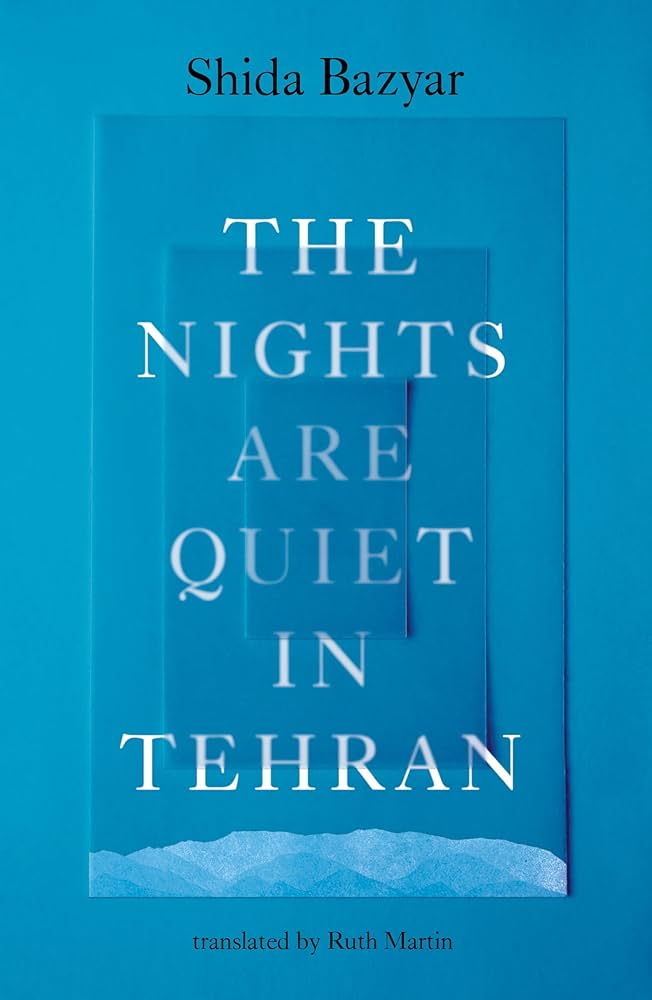
With the Shah’s corrupt tyrannical government on the verge of collapse, Behsad, a young communist revolutionary, fight to establish a new order. In that heady atmosphere on 1979, he experiences the rush of clandestine actions and also discovers the brilliant Nahid, who will later become his love and his wife. The Nights are Quiet in Tehran, by Shida Bazyar, begins with the love story of Behsad and Nahid. Over the course of thirty years, the novel follows the lives of the couple and their children.
The young communists find out their revolution is not to be and flee to Germany before the Ayatollah’s forces root them out. They leave behind friends and family, bearing the scars of failure and exile. Iran changes, at least superficially, exchanging the gaudy authoritarian corruption of the Shah for the religious authoritarianism of a revolutionary Islamic fundamentalism. Tyranny remains, only the style of headgear changes.
Bazyar traces the lives of Behsad and Nahid’s family as they transition to life in Germany. They adjust to a new language, new cultural, and new political norms. Nahid is confused that their friends can protest but not get “disappeared.” We follow their lives in 1989 and the lives of their children decades later. Nahid and Laleh, her daughter, return to Iran in 1999, experiencing the changes firsthand. Laleh, a teenager, finds the restrictions strange and endures embarrassing family reunions. In 2009, we follow the life of Mohad (“Mo”) in college, dealing with his roommate’s relationship woes set against student protests. At the same time he sees a nascent revolutionary movement grow in Iran.
A fascinating look at the life of an immigrant family in Germany, it provides a unique perspective on those who fled the Ayatollah’s wrath. Not all the Shah’s foes were able to stay in Iran and despite the myopic lens of social media, life was not better under the Shah. Surface appearances are easy to mistake for personal freedoms. Bazyar writes with a brilliant clarity, creating believable characters. The speech and thoughts of the family members feels real and lived-in. Special commendation goes to Ruth Martin for her translation. Her admixture of teen slang and Persian code-switching creates an authentic reading experience. It is always a challenge to capture the voice of a character, but Martin makes the characters both familiar and unfamiliar. With the recent meddling of the US government against Iran and with Iran’s funding of international terror groups, it is easy to forget the Iranian people and their everyday struggles.

 The Driftless Area Review
