

Singed, by Daniela Cascella (Equus Press, 2017)
The Baudelaire Fractal, by Lisa Robertson (Coach House Books, 2020)
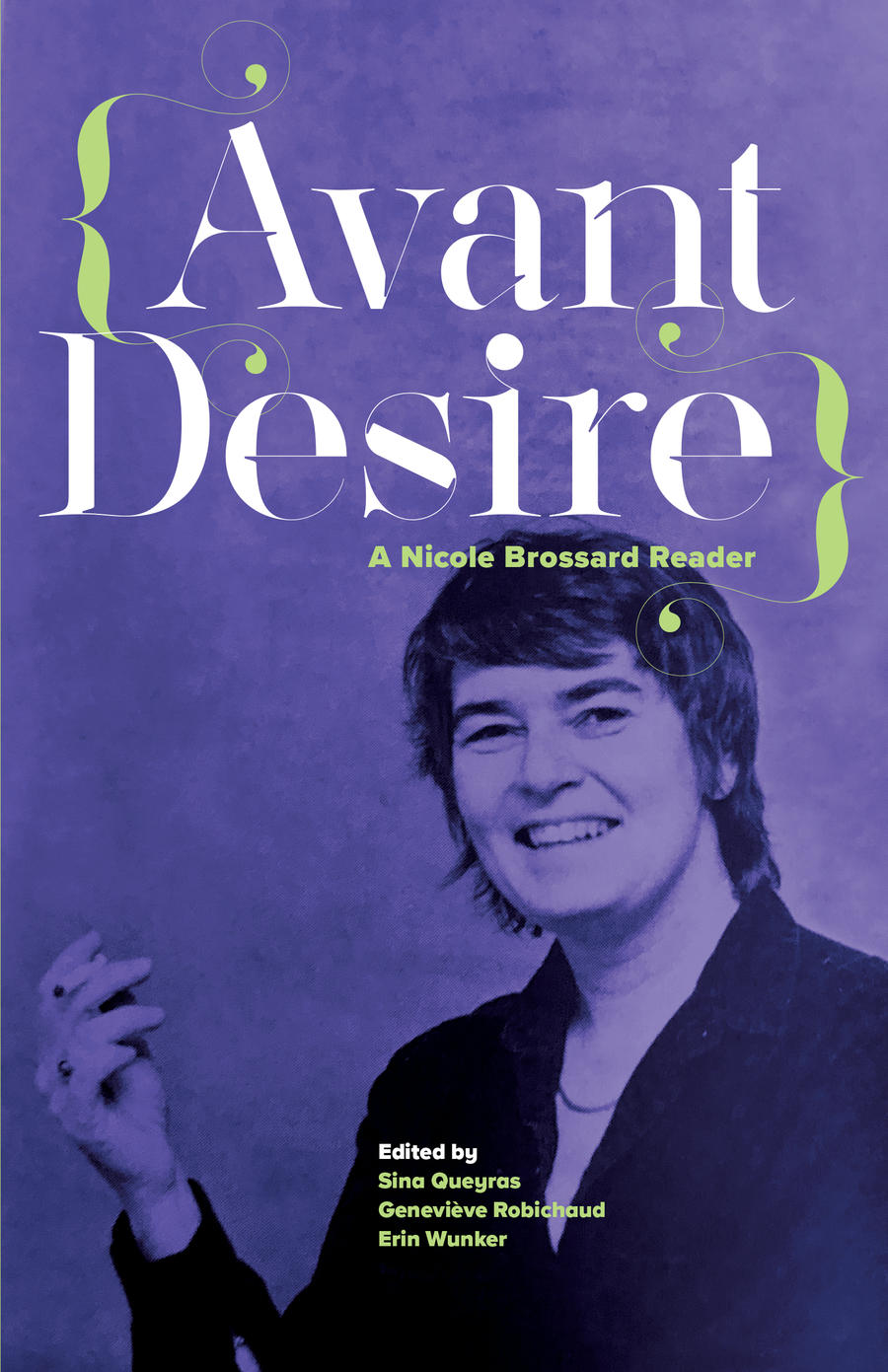
Avant Desire: A Nicole Brossard Reader, edited by Sina Queyras, Geneviéve Robichaud, and Erin Wunker (Coach House Books, 2020)
“But I suffer not a woman to teach, nor to usurp authority over the man, but to be in silence.” — 1 Timothy 2:12 KJV
“Whereof one cannot speak, thereof one must be silent.” / “Wovon man nicht sprechen kann, darüber muss man schweigen.” — Tractatus Logico-Philosophicus (1922), by Ludwig Wittgenstein
“All I say cancels out, I’ll have said nothing.”
— The Calmative (1946), by Samuel Beckett
THE ART OF TRANSLATION
How does art stay current? How does it stay new? One immediately thinks of Ezra Pound’s demand to “Make it new.” But how? In our hyper-mediated world everything that’s new will rapidly become contaminated by the capitalist trifecta of monetization, commodification, and degradation. The latest fad, the most-recent pornographic outrage, the most current scandal, will eventually become co-opted and transformed into a commercial jingle or neutered into an aesthetic style. Some aggregation of signs, patterns, and colors to be utilized and exploited to feed out insatiable consumerist desires. Yet this is more universalized and insidious than the common mis-perception of simply “selling out.”
Amid this maelstrom of economic and political forces, there remain unique and individualized stand-outs. Sometimes the aesthetic object is too strange, complicated, or elusive. It represents an object that cannot be assimilated into the amoebic mass of consumerist co-option. Among the occasional weirdos and misfits include the literary output of Daniela Cascella, Lisa Robertson, and Nicole Brossard. This essay will focus on three works: Singed, by Daniela Cascella, The Baudelaire Fractal, by Lisa Robertson, and Avant Desire: A Nicole Brossard Reader, edited by Sina Queyras, Geneviéve Robichaud, and Erin Wunker.
These three works defy easy categorization. Singed, described by Juliet Jacques, as “polymorphous & polyphonic,” is an exploration of literature and silence. Cascella wrote it in English as a second language (Cf. Beckett writing in French). The Baudelaire Fractal is a meditation of poetry, fashion, race, and sex. In the novel “the poet Hazel Brown wakes up in a strange hotel room to find she’s written the complete works of Charles Baudelaire.” What follows bears the influence of Jorge Luis Borges and Walter Benjamin. Avant Desire is an anthology of fiction and non-fiction by and about Nicole Brossard. Brossard is an out lesbian, political radical, and creator of various literary experiments. A kind of Quebecois Kathy Acker. The anthology itself offers its own brand of literary experimentation, along with examples that push the boundaries of what can be done with literary translation.
In the 1970 work Logical Suite, Brossard explores the entangled issues of artifice and meaning:
“thus sparkles the artifice and exposes itself
[…]
“the code infiltrates
the least attempt at resistance
“henceforth meaning will be double
one too many
the artifice is inevitable
“here’s how.”
(tr. Pierre Joris)
Brossard inhabits a similar poetic space as John Ashbery and Stéphane Mallarmé, where language and meaning can become de-coupled. In “Hotel Rafale” a woman named Cybil Noland has an anonymous sexual encounter with another woman. This becomes a prolonged meditation on desire, relationships, and the body.
“Thus does imagination take us beyond the visible, propelling us toward new faces that will set the wind asurge despite the barrier formed by vertical cities, despite the speed of life that drains our thoughts and leaves them indolent. The priceless eyes of desire are right to succumb to seduction so that one’s familiar, everyday body may find joy in thousands of anonymous others encountered along the way, bodies pursuing their destinies in cities saturated with feelings and emotions.” (tr. Patricia Claxton)
As Queyras, Robichaud, and Wunker explain in the introduction, “Brossard’s work is both thrill and balm […] to enchant avant-garde, feminist, and academic readers […] creating a radical, complex, and influential body of literature.” That is a lot to unpack, yet Avant Desire is an anthology where one can take the time and care to absorb and untangle each piece with a kind of joyous patience.
Among the various translations, we have “Polynésie des yeux / Polynesya of the Eyes” a poem by Brossard translated into English by Brossard. “Silk Font 1” is an anagrammatic translation of “Soft Link 1,” translated by Bronwyn Haslan. At first glance, this might seem over-determined or an attempt at a literary stunt, an ostentatious attention-getter. Despite all appearances, it hearkens back to the rigid restrictiveness of avant-garde pioneers like Oulipo. So this strange literary thing is both traditionalist (re: Oulipo) yet simultaneously new.
Brossard’s work remains perpetually relevant and stylistically new, despite having prolific output since the 1970s. Brossard, like Cascella, explores the issue of silence. “I also believe that silence can activate the white of the page, the light that makes it tremble around intimacy” (from “The Most Precious Things in the Future Will be Water, Silence, and the Human Voice,” a lecture she wrote in English). Earlier in the lecture she says “Silence has always been an ally for me. In fact it is an ally for poetry. It provides moments of fullness and of plenitude when the pleasure of feeling alive is at its peak.”
Singed, despite its mordant subject matter, is a work of fullness and plenitude. Cascella’s novel begins when the narrator is recovering from a fire that destroyed her personal library. It explores her inability to speak, to be forced into a kind of personal silence, and this triggers an incantation of expression and a labyrinthine journey through her own personal archive of memory, music, and literature.
By way of contrast, Lisa Robertson is a Canadian poet and translator. The Baudelaire Fractal adopts the genre of autobiography and translates it into another mind-bending meditation on self and culture. The poet Hazel Brown wakes up to find she’s written the complete works of Charles Baudelaire. But is simply an instrument of production, a tool simply meant to write, or is a distaff incarnation of the Parisian poet of urban spiritual desolation? Is this a second-rate parody of Borges’s author of Quixote or would that be too easy? Will the real Pierre Menard please stand up.

 The Driftless Area Review