

Espresso Shots: The Weather in Fritz Bemelmans Park, by Holly Tavel
Small-sized reviews, raves, and recommendations.
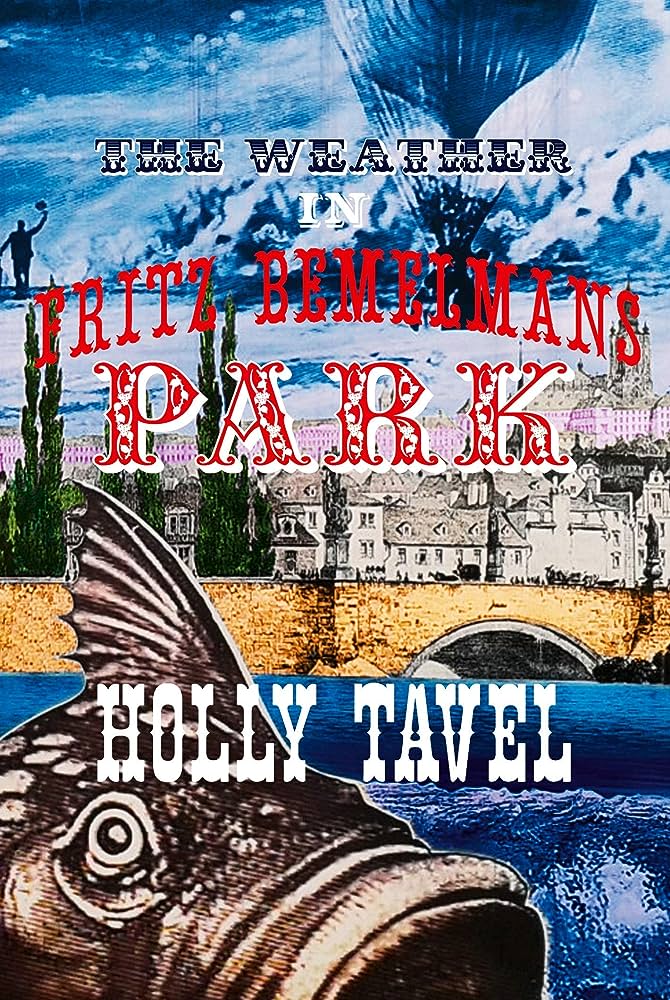
In this collection of short stories, by turns whimsical and menacing, we meet a dying superhero, coma victims who may or may not control the weather, a businessman stranded on an ice floe, and others. The Weather in Fritz Bemelmans Park, by Holly Tavel, is funny and heartbreaking, perplexing and tragic. Her stories could be traditionally told or experimental squibs. The titular tale involves coma victims and changing weather. “We are the volunteers. We volunteer, every second and fourth Sunday, at the Schmetterling-Kiteley Neurology Wing of City Hospital. It is our job to take the people with comas to Fritz Bemelmans Park.” Told in an objectively clinical style by an unnamed narrator (or narrators), the tone is institutional and impersonal. This renders the humor and absurdity all the more farcical. Below the humorous tone is a specter of unnamed menace. A kind of J.G. Ballard waking nightmare given the calculated whimsy of a Wes Anderson film.
The opening story, “On the Mysterious Appearance of Philo S. in Other People’s Photographs,” has a more interrogative style:
Q: what are the variables of Philo S.?
Philo S. does not haunt; he possesses no special powers or supernatural characteristics; he is not an alchemist (as some have believed). He is not treacherous; he does not travel lightly. He is not a metaphor for summers of glory and shame.
The answer goes on some more about what Philo S. is and is not. Photographs appear throughout the story, complete with academic apparatus (Photo #117-a4-23 (Importunate)) and commentary: “As can plainly be seen, Philo S. appears here disguised as a bear.” But one can plainly not see Philo S. diguised as a bear, since there is no one in bear disguise in the photograph. Other examples follow with a kind of predictable negative theology ascribed to Philo S. “Words we could not use to describe the manifestations of Philo S: lurk, lurking, loom, looming, crackerjack, bollix.” Despite the supernatural qualities imbued by Philo S. the one answering the questions describes Philo S. as “no less than an exemplar of the quotidian, a leakage, if you will, in the substrata of the supermundane. […] [A]s visual equivalent to words like mere and fluff.” It is as if Jorge Luis Borges made a slideshow about Tlön and dropped into an episode of Monty Python’s Flying Circus.
Max Bemelmans Park are full of these types of stories, although “type” might be too constricting a term. “Three Pieces for Solo Contrabassoon” is a more experimental piece. The style seems akin to a mathematical proof, albeit one written by a pataphysician. Like this passage:
then we might admonish b that staring at the sun is likely to cause one to go blind;
and if when he is thirty b does go blind,
and if he has in place of a wife a hat rack with two hats (well-worn homburg, straw boater) hanging on it,
and in place of a son a three-legged Appenzeller,
and in place of a daughter a hand-knitted sock with a hole in it;
The substitutions pile up the absurdities, complemented by the matter-of-fact style of a mathematical proof. What is it about? The very nature of the story undercuts any traditional notions about narrator, setting, or plot, unless one ascribes to b and his family that they are characters. Beyond any futile attempt to wrangle a plot around these surrealistic propositions, Tavel exposes the random nature of language, all description being nothing but arbitrary and circumstantial.
The Weather in Fritz Bemelmans Park is highly recommended for those seeking fiction of the uncanny and the weird. Stories range from the traditional to the experimental, from the humorous to the darkly macabre, and everywhere in between. It is a collection both hilarious and deeply unsettling. If J.G. Ballard and Jorge Luis Borges wrote steampunk or Terry Gilliam teamed up with the Church of the SubGenius, it might come close to approaching the tone of these twisted tales.

 The Driftless Area Review
