
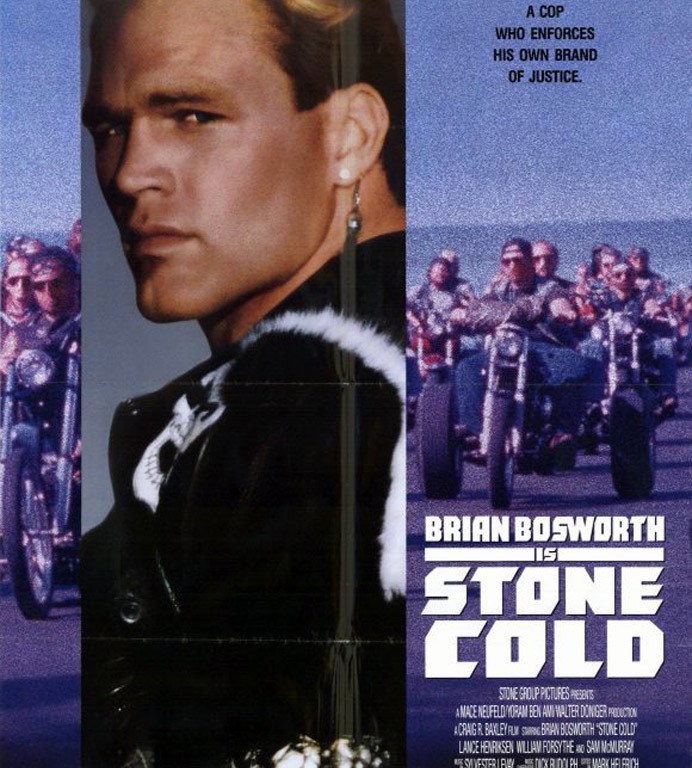
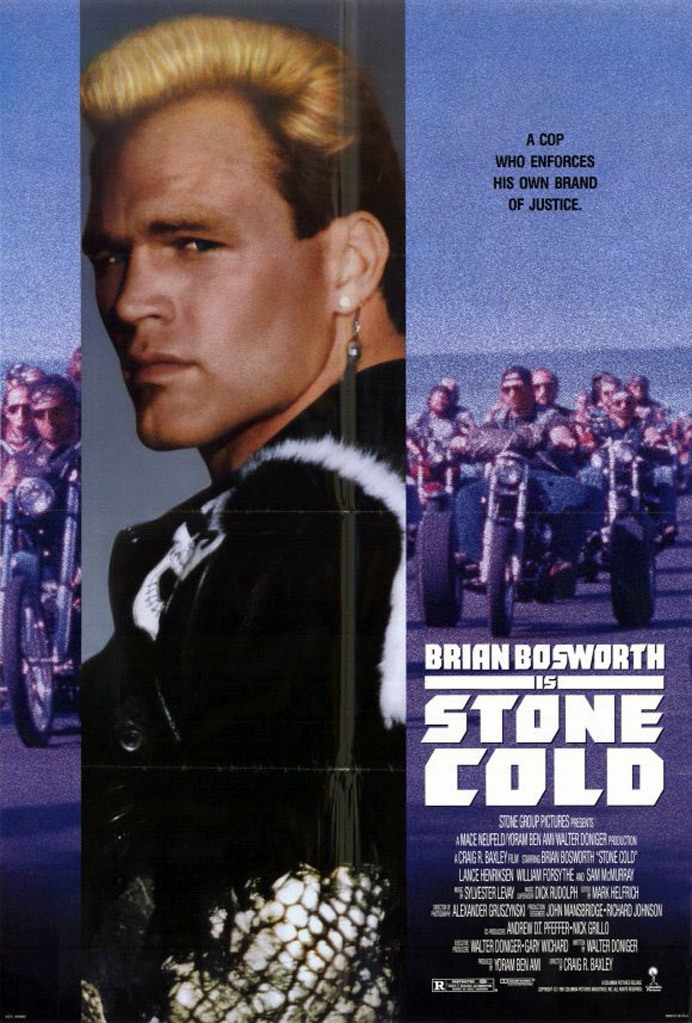
Stone Cold (Craig R. Baxley, 1991)
Best of the Worst: Plinketto #10 (uploaded to YouTube April 22, 2022)
Mike, Jay, Rich, and Special Guest Jack Quaid
“Camp taste has an affinity for certain arts rather than others. […] And movie criticism (like lists of “The 10 Best Bad Movies I Have Seen”) is probably the greatest popularizer of Camp taste today, because most people still go to the movies in a high-spirited and unpretentious way.”
[…]
“Camp is a vision of the world in terms of style – but a particular kind of style. It is the love of the exaggerated, the “off,” of things-being-what-they-are-not.”
[…]
“As a taste in persons, Camp responds to the markedly attenuated and strongly exaggerated. […] The corny flamboyant femaleness of Jayne Mansfield, Gina Lollabrigida, Jane Russell, Virginia Mayo; the he-man-ness of Steve Reeves, Victor Mature.”
[…]
“Camp sees everything in quotation marks.”
[…]
“One must deliberate between naive and deliberate Camp. Pure Camp is always naive. Camp which knows itself to be Camp (“camping”) is usually less satisfying.”
[…]
“Perhaps, though, it is not so much a question of the unintended effect versus the conscious intention, as of the delicate relation between parody and self-parody in Camp.”
[…]
“So, again, Camp rests on innocence. That means Camp discloses innocence, but also, when it can, corrupts it.”
[…]
“Camp is art that proposes itself seriously, but cannot be taken altogether seriously because it is “too much.” Titus Andronicus and Strange Interlude are almost Camp, or could be played as Camp.”
[…]
“This is why so many objects prized by Camp taste are old-fashioned, out-of-date, démodé.”
[…]
“Camp turns it back on the on the good-bad axis of ordinary aesthetic judgment.”
[…]
“One is drawn to Camp when one realizes that “sincerity” is not enough. Sincerity can be simply philistinism, intellectual narrowness.”
[…]
“Camp asserts that good taste is not simply good taste; that there exists, indeed, a good taste of bad taste.”
[…]
“The ultimate Camp statement: it’s good because it’s awful.”
From “Notes on Camp,” (1964) by Susan Sontag
We Motorcycle Mayhem Week with Stone Cold, the legendary Brian Bosworth vehicle. Released in 1991 and directed by Craig R. Baxley, this movie contrasts sharply with R.O.T.O.R. and Warrior of the Lost World for a number of reasons. First, it is a cult classic in its own right. Unlike the two other films, it has a stellar supporting cast: Lance Henriksen, William Forsythe, and Hey! It’s That Guy Sam McMurray. Second, the direction, acting, and screenplay are top notch. No technical incompetence or tonal whiplash. I remember watching it with my college roommates. We enjoyed it thoroughly.
For context, the riffing here is done by the crew at Redlettermedia (RLM). The RLM folks are all filmmakers, fluent in the technical and aesthetic aspects of filmmaking. They review contemporary movies, but also have a variety of series – Best of the Worst, Wheel of the Worst, etc. — devoted to exploring the slosh bucket of video schlock. In the end, after a discussion and deliberation, they vote on a video that’s the “Best of the Worst” and a loser they usually destroy. (Even as someone usually against artistic vandalism, some of these contenders are definitely worthy of destruction. Cinematic atrocities and shameless cash-ins of the most nakedly avaricious variety.)
During this Plinketto episode, they disc landed on Stone Cold. Long story short: They thoroughly enjoyed the film. During their discussion, they wondered if the film was a self-conscious parody of Eighties action movies. Hence the lengthy excerpt from Susan Sontag’s “Notes on Camp.” Could Stone Cold be considered Camp? In the world of Eighties action movies – Predator, Terminator, Rambo, Commando, etc. — they exist as over-the-top experiences. Stone Cold, released in 1991, the very end of The Eighties as cultural zeitgeist, could be classified as more-than-over-the-top. Our hero, Joe Huff (Bosworth), is a human tank of Brock Lesnarian proportions. He is a cop who plays by his own rules and owns a huge lizard as a pet. Huff is an Alabama cop proficient in biker arrests, but when he handles a criminal not too kindly he is put on suspension. He is blackmailed by the FBI to infiltrate the Mississippi biker gang “The Brotherhood.” What follows is cartoonishly violent epic of casual racism, toxic masculinity, and more Confederate flags and Swastikas than a Trump rally.
But was it made to be a self-conscious parody? The jury’s out. Huff’s mission is to infiltrate “the Brotherhood” and foil its leaders plan to blow up the Mississippi Supreme Court. Huff completely fails at his task, but at least there are some cool explosions and a helicopter crash.
Everything about the movie is exaggerated. The hero is a gigantic muscle-head, the baddies are Confederate Nazi outlaws. Yet it succeeds because it takes itself so seriously. The same way Burn After Reading succeeds as a comedy, since all of the actors involved perform as if they are in a serious drama. Stone Cold, although an ultraviolent, raunchy, foul-mouthed extravaganza, is not Deadpool. There’s no fourth-wall-breaking or winks to the audience. But on-screen violence can turn from tragic to farcical by the slightest shift in tone. It approaches the farcical lunacy of a Three Stooges short.
Yet, by the same token, Stone Cold isn’t a bad movie. It is outdated and idiotic, but done with a technical flourish we won’t see until Michael Bay gives us The Rock. (The Rock, for all its action movie bona fides, approaches Camp, especially in the first car chase in San Francisco with Sean Connery driving a Humvee. It’s all Bullitt re-imagined until the wheelchair basketball players start to cross the street. Were there two guys carrying a pane of glass across the street? I don’t remember.)
Stone Cold is violent, stupid, and over-the-top. It’s glorious.

 The Driftless Area Review
