

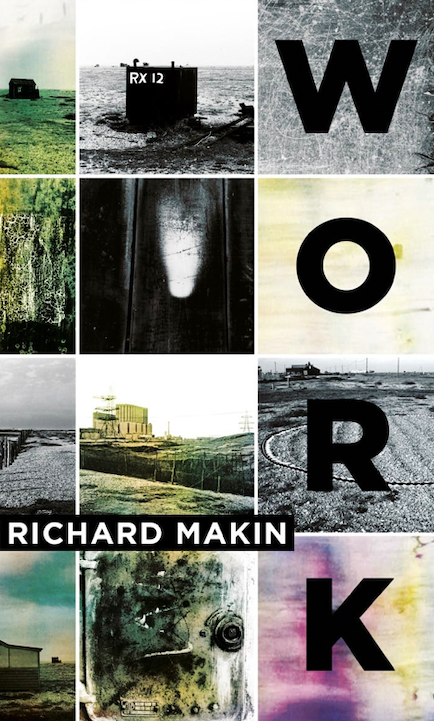


Work (Equus, 2022)
Dwelling (Reality Street, 2011)
Mourning (Equus, 2015)
INTRO: WHAT WE TALK ABOUT WHEN WE TALK ABOUT WHAT WE TALK ABOUT WHEN WE TALK ABOUT WHAT WE TALK ABOUT, ETC.
Richard Makin’s trilogy (Work, Dwelling, Mourning) represents a landmark achievement in (post)modern literature, one that avoids easy classification or explanation. What these three novels are about presents a challenge to the reader. Part of the challenge involves the attributes(or lack thereof) that these novels exhibit. The novels have no characters and no plot and can be read in any order. They have the appearance of automatic writing and peculiarities that can be placed under the umbrella term “surrealist,” although the application of this term should be approached with a degree of caution, since it comes loaded with a variety of presumptions. (Akin to labeling anything exploring the absurdities of bureaucracy as “Kafkaesque.”)
To take a random example, here is the second paragraph in the first chapter of Mourning:
“Valley of Bells. Behaviour. Cognition. A vitrine of night-moths. Requiem. Glossy plate on primary lung. First lesion: splinters of quartz, feldspar, slate in a hard matrix, partly translated, partly adopted. Every word lacks consequence. There’s an inexplicable clouding of the clarity, followed by a long period of quietude.”
It remains obscure what Makin is referring to. The paragraph has the paradoxical appearance of being loaded with specific details yet overall seems utterly baffling, borderline nonsensical. Yet, simultaneously, self-referential (“an inexplicable clouding of the clarity”), although this could equally refer to the “hard matrix” (the matrix being the surrounding geological formation laden with these other elementary particles) and the “hard matrix” of the text, one having to chisel out of the meaning with the tenacity of an archaeologist.
Further along, we come across this passage:
“The thumb we give to Venus.
The index we give to Jupiter.
The mid we give to Saturn.
The leech we give to Sol.
The oracular we give to Mercury.”
The list is reminiscent of both John Ashbery’s poetics and Borges’s love for enigmatic taxonomies (see “The Analytical Language of John Wilkins”). The first two lines seem simple enough, possibly a reference to a work of alchemy or hermetic philosophy, but the fourth and fifth lines throw the previous lines into disarray. The inconsistency is baffling and confusing. What does “the leech” refer to? A historical medical text? And the last lines reference to “the oracular” just seems a bit too self-referential, since the other lines sounded oracular to begin with.
Again, these are only two passages picked out of a 254-page book. The challenge at understanding these three texts seems overwhelming. Yet is that the point? Understanding? Comprehension? Or can they be approached from a different perspective.
This essay seeks to make manifest Susan Sontag’s call to arms: “In place of a hermeneutics we need an erotics of art.” The overweening desire to understand these texts will take a backseat to the alternative of what Makin is doing with language. Or, simply, how Makin do language.
In exploring Makin’s three novels, the bewildering aspect of plotless, characterless fiction will be set against three notable literary innovators James Joyce, Samuel Beckett, and John Ashbery. While each of these aforementioned authors have had mountains of commentary, biography, and exegetical interpretation written about them, Makin presents the opposite. Except for brief biographical tidbits and the occasional interview, an extensive interpretive corpus really doesn’t exist … for the lay reader at least. (It may be different within the confines of the knowledge industry.)
But tackling these pieces from the perspective of tabula rasa offers a unique opportunity for interpretation, exegesis, and speculative theorizing. It’s comforting to interpret a work without the suffocating weight of popular opinion, interpretive orthodoxy, or the outrageous demands of a dead author’s literary estate. Discussions and engagements can be made with these three novels without kowtowing towards whatever “correct interpretation” can be hung over the reader’s head like the Sword of Damocles.
The three authors have been chosen not because of any anxiety of influence, although one is free to speculate based on any alleged traces lingering within these texts. Rather, these three writers will be used in an examination specifically aimed at the weasel word “meaning.” The common refrained aimed at avant-garde and experimental work is, “What does it mean?” To which one can rebut, “Does it need to mean anything?” Or if one doesn’t glean the same meaning as the author intended, one is somehow a lesser reader for it.
These three novels throw sand in the face of the notion that literature has to mean something to be enjoyed. At the same time, this shouldn’t be used as an aesthetic crutch to make the excuse, as tvtropes.org does, with tongue firmly ensconced in cheek, that “True art is incomprehensible.”
But we are again left at the place we began: “What does it mean?”
In full disclosure, I was asked by Equus Books to write a blurb for Work. In that blurb, I sought to summarize what I found challenging and exhilarating about the book:
“When encountering the works of Richard Makin, an urgent question is raised: How does one actually read this? One of the first sentences in the book is: ‘Word order is an allusive presence, a residue.’ In order to understand this linguistic “residue,” one has to alter one’s perceptions about how narrative operates. Work, like Makin’s other works, is allusive, elusive, solipsistic, and playful. Offering no anchor to the reader – a linear story, identifiable characters – instead, we are set adrift on a sea of words. Images and passages fade in and out, possible genres – science fiction, detective noir, autobiographical confessional – cling to the mind and then disappear just as easily. ‘I have inherited the magnetized corpse of an abandoned empire,’ he says. This can be read as a passage from a speculative fiction novel or is Makin’s own assessment of the state of contemporary fiction. Work is fiction as a polysemic vehicle and mise en abyme.”

 The Driftless Area Review