

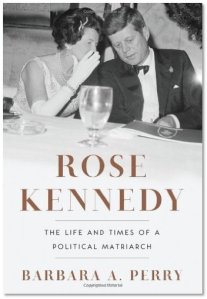
Rose Kennedy occupies a legendary place within modern American history. The mother of nine children, many that attained greatness, Rose Kennedy also experienced a grief so monumental most people would find it incomprehensible. Rose Kennedy: The Life and Times of a Political Matriarch, by Barbara A. Perry, is the first work to focus on Rose Kennedy in more than two decades. (Another work, Iron Rose, by Susan Crimp and Cindy Adams, came out in 1995.)
In the art of biography, two major themes are perspective and change. While no shortage of biographies have been by and about the Kennedy family, there have been very few about Rose Kennedy. This unique perspective leads to the theme of change, be it historical, political, and personal. Rose Kennedy, born in 1890, was an individual who preserved her Victorian values into her adulthood. Combined her with super-longevity, passing away in 1995 at the age of 104, she carried herself informed by the Victorian values of prudence, decency, and industriousness. (Another famous political figure who preserved his own Victorian morality was British Prime Minister Winston Churchill.)
Ms. Perry, who wrote a biography of Jacqueline Kennedy, does a fair job balancing the positive and negative aspects of Rose Kennedy’s life. Neither hagiography nor hatchet-job, Rose Kennedy seeks to add value to the immense literary and historical corpus by delving into the family archives. The access to the archives of the Kennedy family reveals Rose Kennedy as domineering, image-obsessed, and defensive. Depending on the situation, not necessarily bad attributes. Despite belonging to a political family and marrying Joseph P. Kennedy, a member of a rival Boston political clan, Rose kept out of the political limelight. She chose to raise her large family and once Jack, Bobby, and Teddy became active in political life, she set about protecting the Kennedy legacy and establishing the mythology of Camelot.
The image-management and public relations around her children did have a negative side. After her husband Joe, the former ambassador to the Court of St. James, unilaterally decided to have her developmentally disabled child, Rosemary, undergo a lobotomy, Rose kept the information her daughter secret for decades. As times changed, so did Rose, adapting to the changing media and American cultural expectations. Her behavior towards Rosemary illustrates this, with Ms. Perry writing eloquently about Rose Kennedy’s struggle between keeping a positive spin on the Kennedy Family in the media and her guilt about how Rosemary was treated. In the end, Rose helped establish the Special Olympics as well as helming several foundations organized to benefit the mentally retarded.
Ms. Perry’s digging through the archives reveals information long since buried in order to maintain the facade of Kennedy integrity, especially in regards to Rose. Because the public has seen Rose Kennedy as a kind of secular saint, institutions seek to bury unpleasant truths. In the Notes, Ms. Perry discusses having redactions removed from specific sections of documents, including the various medications Rose Kennedy took throughout her very long life. At other times, Ms. Perry did not succeed in having redactions removed. But it is a good sign that the American public is moving in the right direction in terms of institutional secrecy. (The Wikileaks, Bradley Manning, and Edward Snowden scandals point towards a public accepting and even demanding more transparency from institutions built upon secrecy and lack of public oversight. As Sean Wilentz related in his recent history, The Age of Reagan, terrorism and the secrecy of the national security state have made it more challenging for historians and researchers to do their jobs. One can’t tell the whole story if one doesn’t have all the information about said story.)
For fans of the New Frontier, Camelot, and the Kennedy Mystique (and Curse), Ms. Perry’s book sheds light on this much talked about family. She adds to the relatively small pile of books written about Rose Kennedy, a woman who endured incomprehensible tragedy, and who lived for nearly half the life of the American republic. Neither heroine or villainess, Rose Kennedy shines through as an extraordinary human being. Ms. Perry brings a much-needed human face to a family that has become populated with historical icons and mythological archetypes.

 The Driftless Area Review