

A series dedicated to literature in translation whether classic or contemporary.
Originally published in Korean by EunHaengNaMu Publishing Co. (2023)
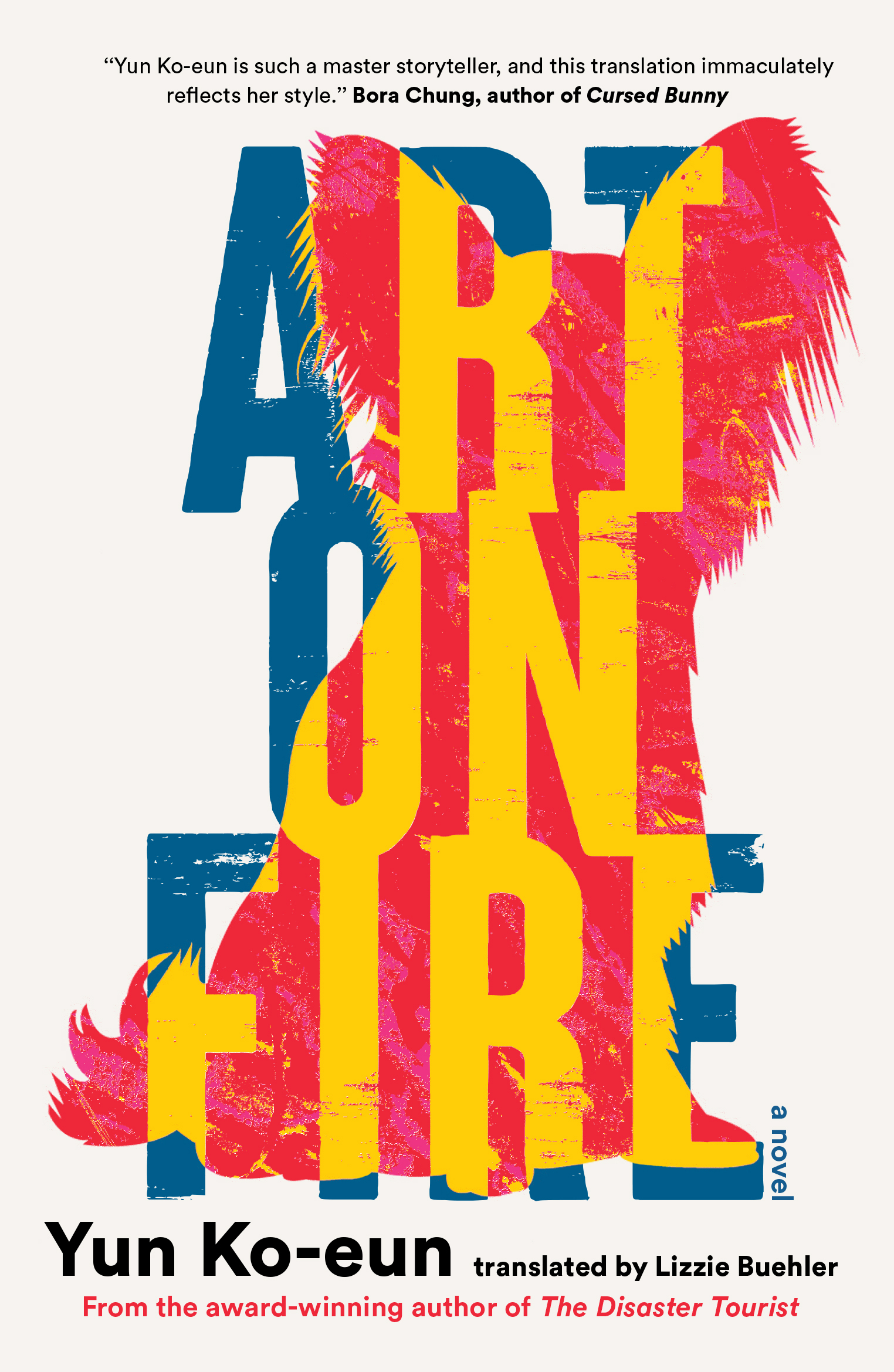
Translated from the Korean by Lizzie Buehler
Published by Scribe (2025)
An Yiji works for Bballi, a Korean food delivery app, with her artistic career on hold. One day she gets a message to be an artist-in-residence at the prestigious Robert Foundation. She jumps at the chance, leaving her dead-end job and hoping the residency will bring fame and prestige to her artistic career. But two things make the Robert Foundation a unique cultural entity. First, it is run by Robert. Robert is a dog. Second, at the end of the residency Robert chooses an artwork to be incinerated.
Art on Fire, by Yun Ko-eun, and translated by Lizzie Buehler, is an absurdist tale of art and power, along with being an of-the-moment portrait of late-stage capitalism and the consequences of climate change. When Yiji travels to the United States, she encounters a laundry list of difficulties in actually getting to the Robert Foundation. She arrives in Los Angeles as wildfires rage around the city. Stuck in a dingy hotel and burdened with the Robert Foundation’s miscommunications and victim-blaming, she finally arrives at the Robert Foundation’s compound in Palm Springs. It is a heroic effort, but also a masterpiece of the comedy of anxiety. During her journey to the compound, she meets an aspiring actor and has a meal in a weird deadmall where the clocks are frozen in time.
The novel’s tone is an admixture of Being John Malkovich and J.G. Ballard. Despite the Robert Foundation being run by a dog, no one seems to find that fact absurd or strange. Everyone – staff, fellow artists, tourists, etc. – go about their daily business without recognizing this. On top of this institutional absurdity, the world burns. Or at least California. The deadmalls and ecological catastrophe recall Ballard’s early and later works, where he gave burning and frozen worlds a mythical atmosphere and he plumbed the psychological dread of freeway overpasses, apartment high-rises, and traffic islands.
An Yiji experiences her residency with a strange acceptance, but she can’t help but start to peel back the layers of oddness. When she has dinner with Robert, it is an elaborate ritual akin to a Michelin-starred meal or the courtly hyper-mannerisms of King Louis XIV. Robert communicates with her either through bizarre notes or a bevy of translators. During the meal, Robert’s communications go through a translator “box” and then a dog-to-human translator and another who translates English to Korean. Even though An Yiji can speak fluent English. Before the meal, Robert’s message to An Yiji included phrases like “the fierce and beautiful heatwave and spectacular wildfires” and “a magnificent hurricane.” His tone is both insulting and oddly off-putting. Either he doesn’t know how to use language properly, or he does and simply doesn’t care.
Art on Fire, by turns comical and apocalyptic, is a brilliant satire of the art world, late-stage capitalism, and climate change. An Yiji discovers the Robert Foundation’s obscene consumption of water, even as wildfires rage outside. The Robert Foundation is also a hilarious critique of the art world’s insularism, hero worship, and craven subservience. Like a doomsday cult, everyone around Robert treats him like The Leader who isn’t allowed to be questioned. It is a mini-dictatorship buoyed by capital – Robert was a pet owned by a rich benefactor – and a cult complete with rituals, idols, and a calendar. There is even a funny subplot involving Robert’s feces and An Yiji’s art. Art on Fire is an enjoyable romp through our current plutocratic hellscape, with Yun Ko-eun skewering the sacred cows of fine art and the oligarchs who buy it.

 The Driftless Area Review