
Reviews of Biographies, Autobiographies, and Memoirs
Karl Marx. The name itself conjures up demonologies and hagiographies, depending where one lands on the ideological spectrum. Hyper-prolific writer. Professional revolutionary. Academic philosopher. Intellectual genius. Pedant, hypocrite, poetaster. Victim of personal financial calamities and personal health problems. One could go on forever praising and damning the man. With all this personal, political, and historical baggage in tow, it becomes a challenge to actually know Marx. In particular, to know Marx as a person. Beyond the iconography, hero-worship, and, to put it kindly, mixed legacy of Marxism, a biography is a means to cut away this detritus and focus on Karl Marx as an individual person. What was his family life like? His student days? His family history, since his father was Jewish and converted to Christianity. And how did Marx’s growing up in Germany in the aftermath of the Napoleonic Wars effect his political and philosophical outlook?
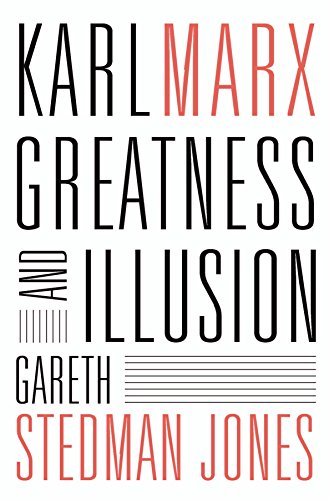
Karl Marx: Greatness and Illusion, by Gareth Stedman Jones, seeks to answer these questions. Jones, is Professor of the History of Ideas as Queen Mary University in London and Director of the Centre for History and Economics at the University of Cambridge. His grounding in the history of ideas and economics gives him the required background for tackling such a titanic figure like Marx. He tackles this challenging subject in an equally epic book (hardcover: 750 pages; Notes and References 112 pages). Throughout we encounter both Karl Marx, the person, and the times he lived in. Granted, Marxism is instrumental and influential within the History of Ideas, but these ideas, generated by Marx, didn’t arise out of an abstract vacuum. He was influenced by both his teachers in the philosophy faculty and the times in which he lived.
Jones excels when he sets up the scene. This might involve a lengthy explanation of the geopolitical situation of “Germany” during Marx’s childhood and young adulthood. (The quotation marks are not meant in irony so much as the nation-state of Germany didn’t exist as such, not least until Bismark’s campaign of national unification. Prior to this the shattered Holy Roman Empire was a confusing amalgamation of kingdoms and principalities until Napoleon’s brute force “unification” into the Confederacy of the Rhine.) Napoleon’s conquest was a mixed bag. It brought with it revolutionary liberties inherited from the French Revolution (trial by jury, emancipation of the Jews, etc.) and national humiliation. It is in the unstable status quo ante that Marx grow up. Napoleon is summarily defeated, but along with that, so are the liberties enjoyed by the citizens. In its place, the ossified carcass of pre-Napoloenic monarchies are hoisted back on their golden thrones and somehow they connive their willing subjects that the Napoleonic Wars never happened. This calcified necrotic edifice, conservative and suffocating, hostile to dissent, and bureaucratically inept, is the atmosphere Karl Marx endures when he attends university.
The esoteric nature of the philosophy academy is brilliantly captured by Jones. He elucidates student life in Berlin. “[T]he capital of Prussia, a state without a parliament or independent judiciary. A constitution, promised by the king in 1815, had never materialized. There was no free press as heavy censorship was particularly applied to Berlin newspapers.” (This sounds either like Trump’s fantasized second term or North Korea today.) At this time, Marx settles on acquiring a doctorate in philosophy, a kind of crab-wise dodge to attain political enlightenment from within the Prussian state. Marx becomes a student of Hegelian philosophy and sought to re-engineer it to better fit with a post-Revolutionary, post-Napoleonic Germany. One can see this in the later political writings of Marx, since he saw revolution as a schematized progressive process. Modern eyes cast a more jaundiced view of the revolutionary political process, especially after the bloody slaughterhouse of the twentieth century.
His student days and later work in journalism set him up to his magnum opus, Das Kapital. Jones offers a bracing criticism of Marx’s underlying premise of surplus-value:
“Karl’s argument contained fundamental flaws, which he was never able to overcome. In the Grundrisse, his treatment of the value problem was obscure. In the first volume of Capital, he evaded the most difficult issues surrounding the question by confining his discussion to production, while his reluctant efforts to confront the problem in the unpublished second and third volumes were unsuccessful.”
But the critique is not all damning, because Jones also summarizes the triumphs of Das Kapital, even amid its failing as a revolutionary program for worker liberation:
“Karl’s achievement was precisely in the area for which he affected to have least regard. This was the work which had developed from his writing and research for the New-York Daily Tribune and for the various lectures he delivered from the late 1840s onwards. He was able to connect critical analysis of the current capitalist economy with its longer term historical roots. The foregrounding of production led him to uncover unfamiliar tensions within the modern workshop or the automatic factory. Through his determination to trace the progress of the capitalist economy as a whole, and in particular the consequences of new forces of production, he became one of the principal – if unwitting – founders of a new and important area of history enquiry, the systematic study of social and economic history. He inaugurated a debate about the central economic and social landmarks in modern history which has gone on ever since.”
While The Communist Manifesto and The Eighteenth Brumaire of Louis Napoleon are brief bombastic works easily read in a single sitting, the first volume of Das Kapital remains an essential read for anyone interested in the social, economic, and political circumstances of worker life in nineteenth century Europe. It brings together a staggering documentary account of worker exploitation. One doesn’t have to agree with what Marx is saying to find value in the work. But that’s Critical Thinking 101. Read Karl Marx. Read Adam Smith. Read Ayn Rand. Read Bakunin and Sartre and Barthes and Freud. Treat none as gospel and take what you want from their writings. Marx’s legacy is divisive, to say the least, but the capacity to understand and apply “marxist criticism” to a text is instrumental to understanding it. It shines a new light on everything from “(I Can’t Get No) Satisfaction” by the Rolling Stones to Fight Club to Cagney & Lacey episodes.
Beyond the textual criticism of Marx’s works, Karl Marx: Greatness and Illusion delves deeply into the countless personal troubles endured by Marx. At one point, hard up for cash, Marx wrote some essays, but couldn’t mail them because he lacked the funds. Then there are the health troubles, including the notorious hemorrhoids. His personality could be less than accommodating, especially in his earlier revolutionary days, when he was something of a control freak and wannabe-dictator. With political agitation came the inevitable bouts of exile, first to Belgium and the finally to Great Britain. But exile provided opportunities, since his access to documentary materials in the British Library allowed him to bulk out Das Kapital with the primary documents needed to defend his theories. In later years, tempered by personal and political failures, he became more of a reformist than revolutionary. Marx eventually died and was buried in England, a kind of secular Moses barred from his homeland but casting an enormous shadow on the twentieth century, for both good and ill.
Karl Marx: Greatness and Illusion is an indispensable volume, an epic about a man and his times. It strips away the religious rhetoric spewed by sycophants and enemies, casting him as messiah or devil. This biography offers a clear picture of who Karl Marx was, warts and all, in addition to lengthy passages exploring the philosophical, political, and economic background in which he grew up and developed his theories.
Happy Labor Day!

 The Driftless Area Review
