Posts about poetry, poiesis, and poetics.
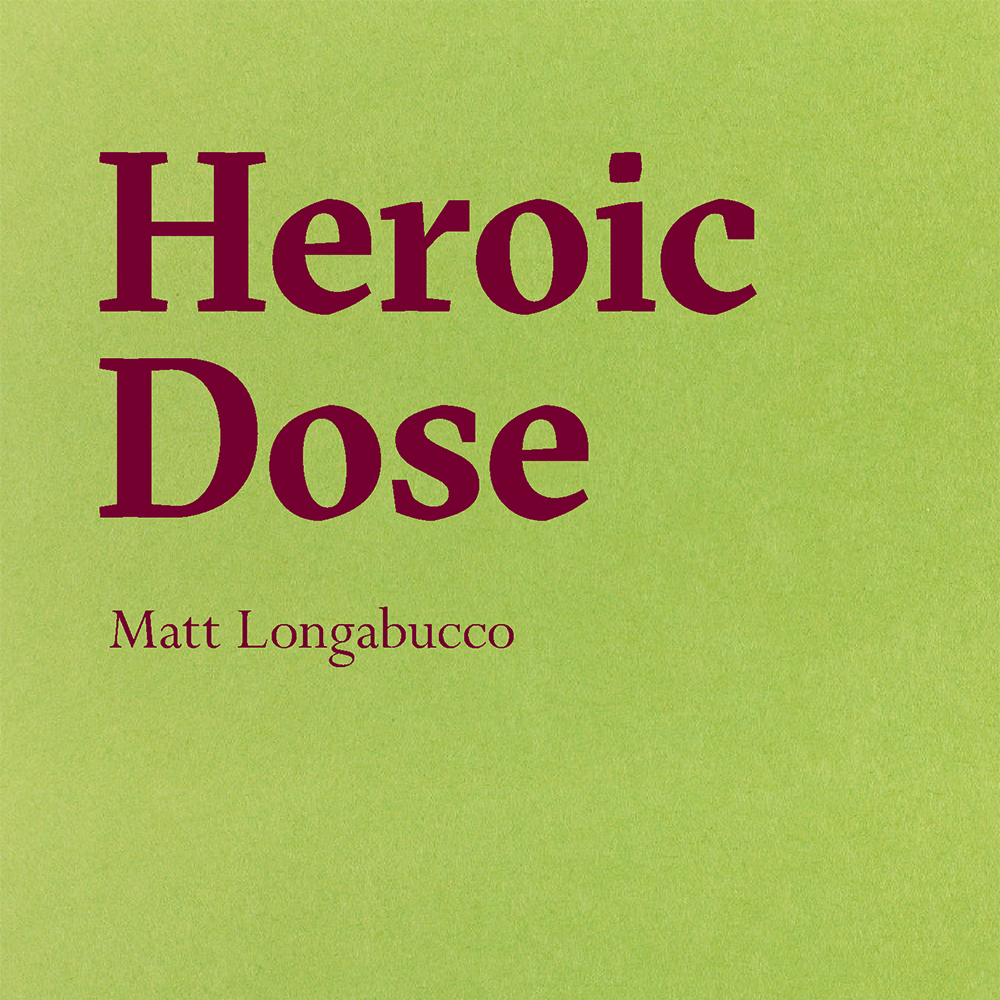
With a delicate balance between the everyday and the sublime, Heroic Dose by Matt Longabucco ensorcels the reader with narrative and serial poems. Like a ragamuffin Ezra Pound, he channels both ancient and modern rhythms, slamming them together into something new. “Waiting to Go Down” begins with the Poundian “and”:
And afraid, and everybody’s nice
about it. But they get restless
and it’s time.
Instead of a long poem about Odysseus, “swart beams,” and animal sacrifice, this initial short poem juxtaposes contemporary images and elegiac rumination. “Over there a group of Orthodox girls / jump rope and it’s tricky with the long skirts / but they seem to do okay.” The mind is compared to a refinery and then to the stock market. Before the poem ends, he gives us the image of:
My friend’s father on his deathbed
kept asking for lettuce and mayo sandwiches,
eventually she realizes that was what he’d eaten
in the years when he was desperately poor.
Ways in Which Objects Try and Fail to Matter.
To those who have read too many books, this poem could read like a parodic echo of The Cantos opening canto. To others, it could be read as an alchemical admixture of past and present bleeding together, wry observations about life and death. Orthodox girls jumping rope and a friend’s father on his deathbed. (One could also make parallels to this and the concluding minutes of The Godfather, Part II, with its Proustian recollections of childhood and fatherhood, set against gunshot echoes of a Lake Tahoe fratricide.)
The back cover blurb explaining Heroic Dose describes “the reluctant pathos of narrative’s pyrrhic salvaging of lyric selfhood.” In these poems, Longabucco bobs and weaves between sharp, lapidary images – the city, marriage, academia – and fumbling attempts to reach a mystical sublime. He describes the tragic saintly afterglow when “[…] these seekers / who find themselves, when they least expect it / lodged waist-deep in the muck of the world / empty, impotent, dumb, diffuse, without hope of / regaining the road, loitering in what Saint John called / a place where none appeared[.]” (“A Place Where None Appeared”)
In an earlier poem, he laments at the futility of language:
I want my language
to adorn, transmit, and germinate
not spend more words than necessary
describing capitalism
to the broke, who know it best. (“Heroic Dose”)
Also, don’t recommend Nickel and Dimed to someone who has been ping-ponging around in a multi-year-long temp job purgatory. While Marx proved one doesn’t necessarily need to be a worker to understand how economic doesn’t always benefit the worker’s best interests, by the same token, these self-same workers can also spot a tourist from a mile away.
The above passage bespeaks Longabucco’s desire to create something Poundian. Old Ez did desire to communicate a better kind of economics, one untainted from the profit-motive, corruption, and waste. His attempts at educating the masses on the evils of capitalism failed miserably, drowned in the muck of fascism’s glamour and the moral laziness of anti-semitism. Longabucco knows the stakes, but he also stubbornly refuses to give up. There are glimmers of socio-economic critique, but it doesn’t devolve into the merely didactic or moral scolding. He is far too tough on himself, holding up a mirror to his real and alleged failings. The artist’s hardest critic is themself.
Heroic Dose is a whip-smart collection of poetry, published by the small-press Golias Books. It is both a resuscitation of the traditional narrative poem and a sardonic dissection of the same, an elegantly designed poetic machine, but one with its inner workings exposed.

 The Driftless Area Review