Wednesday Poetry Corner: Numbers, by Rachel Blau DuPlessis
Posts about poetry, poiesis, and poetics.

Numbers
Materialist Press 2018
Personal copy: No. 183/200
Numbers, by Rachel Blau DuPlessis is premised as “a one-woman collage kabbalah, a work of artisanal cosmology, decoding and interpreting numbers zero to five.” It is one of her post-Drafts “interstitial” works, lying outside the corpus of her multi-volume long-form poem. The subject matter – numbers – small but profound. Like Drafts and the previously reviewed Interstices (Subpress Books, 2014), these are poems that examine language and, in the specific case of Numbers, the tension between language and mathematics.
When one thinks of numbers, the first thoughts usually center around the concept of mathematics, with the specific connotations of mathematics being a realm of calm, collected reason and rationality. The equation 2+2=4 is beyond obvious, a veritable tautology, a metaphysical certainty. The equation 2+2=5 has been the shorthand for totalitarian insanity. To acknowledge this equation (because it simply doesn’t equate) is the stuff of madness. The sleep of reason may produce monsters, but this absurd anti-equation keeps those same monsters in power.
Language, by contrast, is a messy proposition. Granted, the discipline of linguistics was created to envelope the messy, transitory, ever-evolving moving target of language with a scientific legitimacy. Linguistics seeks to pin down language like an entomologist pinning down a butterfly in a display box. But, as is self-evident with these explanations, language is a difficult beast. These explanations of language and mathematics are too broad, too glib, and penned by a non-expert. (The reviewer is neither a mathematician or a linguist.) But these glib, broad, subjective explanations are purposely given to establish at least some sort of intellectual baseline. Agree or disagree with the broad outlines, the limitations of language seeks to contain an otherwise labyrinthine prospect well outside the confines of a simple poetry review. Long story short: Math rational, language not. TLDR.
Numbers plays with these tensions. It is telling that DuPlessis considers this work a kabbalah, since that strain of Jewish mysticism relies on gematria. With gematria, letters are given numeric value, and within the kabbalistic tradition, the interpreter teases out spiritual meaning through the interrelationships between letters. One need only to dip a metaphorical toe into the waters of the Zohar to understand (or attempt to understand) this complex interpretive process. (This reviewer highly recommends the Daniel Matt translation of the Zohar, published by Stanford University Press.)

To further complicate matters, DuPlessis has created collages that both comment on the poetry or are actual visual poems in themselves. In the process she examines the numbers zero through five, with a set of poems on the number pi. Pi throws the heretofore assumed rationality of numbers and math into a dizzying maelstrom of non-repeating decimals. For her project DuPlessis only dealt with pi to 100,000 places. Since pi itself goes on to infinity, the poet had to create her own artificial barrier. (The movie Pi has a plot involving a reclusive math genius struggling with his sanity. In real life, there have been mathematicians who went “off the grid” and vanished into the forests of insanity. The price of genius can be punishing.)
Numbers is another attempt by DuPlessis to create “helpless notebooks, / a.k.a. not-books,/ and unbegin / ungain.” (Interstices) She unbegins with a series of prefaces. She asks “Why flatten the polysemous bubbles / Into cardboard?” The act of art-making delimits reality into a one-dimensional space, further replicated by the dimensions of the page. While the collages probably have a three-dimensional quality, at least in the lived experience of an art exhibition, when duplicated on a book’s page they are rendered flat. This calls attention to the human activity of sanding off Reality’s ragged edges.
For zero she plays with the number that means nothing, a thing that represents no-thing.
“Not to say meaning
and strangeness,
a whole semiotics—
signs of being which is nothing—”
Zero, like pi, is a bizarre particle within the universe of mathematics. “Something that is / a total mystery of fullness / and of nothing—which is also something.” This “mystery of fullness” occurs whenever a zero is appended to the end of a number, the very opposite of nothingness. (This becomes disastrously apparent whenever one misses or adds a zero to an equation. What was otherwise an orderly state of affairs gets thrown into chaos.) This mystical quality of zero – simultaneously no-value and added-value – throws a contradictory quality into mathematical rigor. Numbers shouldn’t contradict each other. And in language the word “literally” should mean “literally” not “metaphorically.” That’s, literally, the whole point of the word!
Using rhyme, itself a kind of aural/oral symmetry, DuPlessis talks about:
“Zero was a dead one.
One then equal one plus nought
which made the one, odd sum, or even 10
declare polyphonous paths
to pluralized thought.”
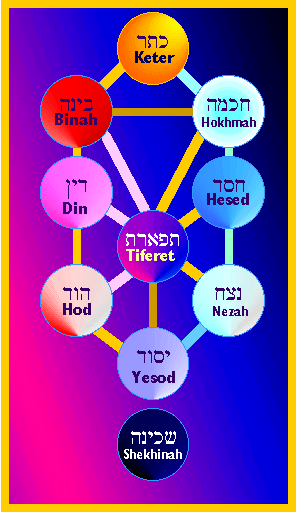
Previously in the same poem she tells about how “the binary too perfect. Needs / unevenness, so three came in[.]” Somehow the rhymes ring false, because they expose the artifice of language. It reverberates as something clever, arch. Reminiscent of the first season of Agents of SHIELD, all clever quippiness smeared over a vessel of narrative emptiness. (Future seasons showed a market improvement, but the first season stands out as a vacant husk, a useless carapace whose only function was as a weekly promotional tool for MCU tent-pole movies.) But back to the matter at hand, the “polyphonous paths / to pluralize thought” brings one to the kabbalistic concept of the sefirot (aka The Tree of Life). So many pathways, so many relationships and inter-relationships, which, despite its formalism, can yield an infinity of interpretations. The Zohar is the metaphorical tip of the iceberg to a vast literature. The inevitable infinity can become overwhelming, a “numbness from numbers, / paralysis from tally—”
The sequence continues with numbers 2, 3, and then π. But π is both a mathematical symbol and a letter of the Greek alphabet, once again the rational clarity of mathetmatics gets muddied by the polysemic bubbles of language. Within the rational edifice of mathematics is pi, an irrational number. It “cannot be a clean fraction, cannot be divided—except by itself. 22/7. Not, it’s actually less. What? We don’t exactly know! […] An infinite series and perfectly random. That’s what we know to thirteen point three trillion places. But who understands ‘trillion’? So much for π.” We understand billions, at least to a certain degree. Carl Sagan’s “billions and billions of stars” and billionaires (Musk, Bezos, Jessica Alba, etc.). Billionaires represent a certain socio-economic anomaly, heroes or villains depending on where one stands in the political spectrum, but even that is precipitated on visceral emotional judgments. Several billion dollars may be good or bad, dependent on the context, and/or tone of voice of those commenting on said billions. But do you even know what a billion dollars looks like? Physically, by square footage? For most … and even the possessors of … those billions of dollars, it remains an abstraction, as abstract and meaning(-less/-full) as the concept of God. And yet! And yet … billions are an order of magnitude less than trillions. Billions is abstract, trillions is literally incomprehensible! (Literally meaning metaphorically.)
To wrap one’s brain around the concept of pi becomes maddening. DuPlessis explores this madness by a random set of numerals that seems oddly rational, yet is only a mockery, a parody of rationality:
“At the end of 100,000 digits of pi
came the last 6 digits of π
in that set, 362541,
and it was just another day.”
The sequence 362541 is like a Bizarro World reflection of 654321, the mock-rational set coming at the end of 100,000 digits, the large number oddly symmetrical, representing a sort of closure from ungainly numbers like 999,999 and the palindromic 100,001. But our gut reactions jerk us away from the fact we are pattern-making creatures. We have been conditioned to find comfort in patterns. Patterns bespeak predictability, patterns become the stuff of habit, although habit is both benign routine and malevolent addiction. We can become slaves to habit and routine, frogs in the slowly boiling water.
Pi continues to confound:
“its numbers never settle.
Yet pi retains the postulated
perfection of the circle,
as compared with the dinted
zim-zum, zero-sum
of writing. Of words auretic.
Of words redundant. Of words
as perfectly imperfect.”
Pi is like those foreign terms untranslatable into English. Gemüt and ch’i, both representing fundamental aspects of German and Chinese culture respectively, yet is near impossible to translate. In an American English context, can one adequately define “dude” in a single sentence. Depending on context, inflection, and the user’s demographic profile, “dude” takes on any number of meanings. Dude? Dude! Dude!
After poems on 4 and 5, DuPlessis ends with “&c.” (meaning et cetera, or, “and so on…”). She says poetry is “the opposite, half the opposite, the half-truth of opposite / will ruin the clarity / already ruined / by ideologies of ‘the exact.’ // This was an experiment in opacity / teasing exactness with these endless little shims. // I open the dream.” This sounds an anti-chorus to Ezra Pound’s lament: “And I am not a demigod, / I cannot make it cohere.” (The Cantos, Canto CXVI) Pound became a prisoner of “ideologies of ‘the exact,’” deluding himself into believing he knew the fundamentals of good government, economics, and history. What he had was a colossal ego and toxic hubris combined with a virulent antisemitism. Yet he also illustrates the human desire for clear categories and rational explanations. He was both an anti-American traitor who supported Mussolini during the Second World War and also one of the greatest American poets.

Instead of a clear cut “either/or” we get a messy “and/both.” Ted Nugent is a misogynist dumpster fire of a human being, yet “Stranglehold” and “Cat Scratch Fever” still rock. These facts “ruin the clarity / already ruined.” The melancholy tone of poem’s end is understandable, since it was published in 2018 and probably written during the Trump “presidency.”
The phrasing of poetry being “the opposite, half the opposite, the half-truth of opposite” recalls Karl Kraus’s aphorism about aphorisms: “An aphorism can never be the whole truth; it is either a half-truth or a truth-and-a-half.” Kraus, an Austrian of Jewish extraction, was an early, vocal, and vituperative critic of fascism, hack journalism, and institutional stupidity. DuPlessis harnessing both Pound and Kraus into the subterranean context of the final poem is nothing short of astonishing. The experiment in opacity sometimes letting the light of meaning shine through, if not intentionally, then accidentally, inviting a randomness, like pi, into an otherwise brilliant book of poetry notable for its playfulness and intellectual rigor. Numbers is a beautifully rendered poetic artifact, a rollicking admixture of visuals and text, sprung to tease forth the tensions between numbers and words, an exposure of the random temporal nature of both. It’s not an easy read, but in a book about numbers, it shouldn’t be expect to be as easy as pie.

 The Driftless Area Review